
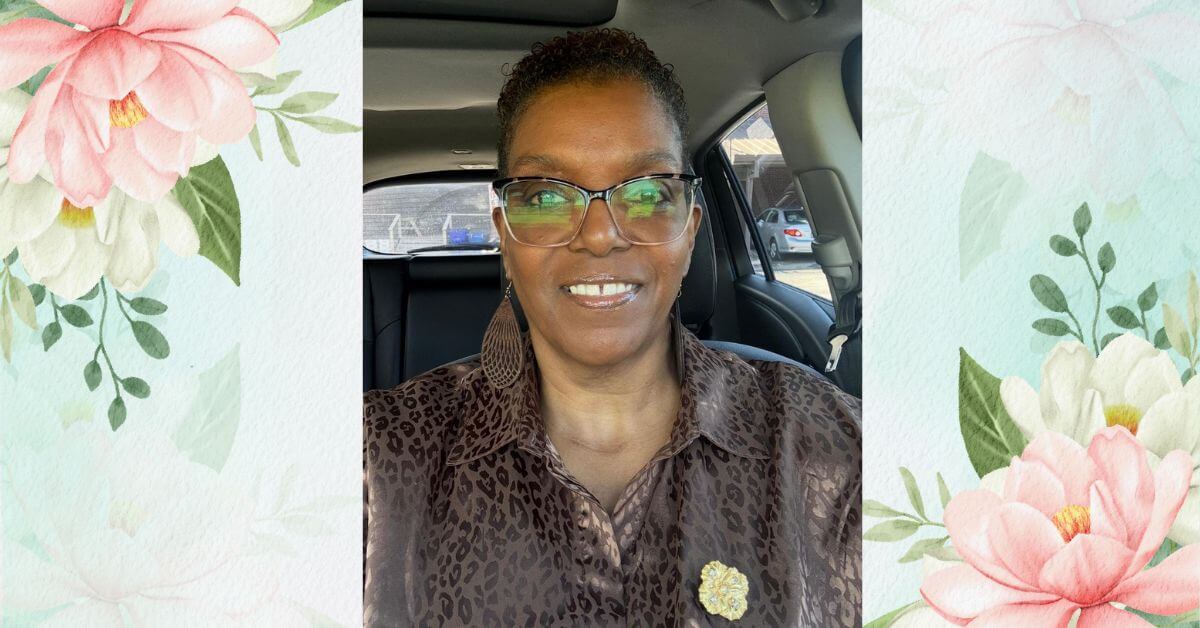
Woman to Woman: A Survivor’s Journey through Endometrial Cancer
Key Takeaways
- Midlife is a time when women feel particularly unsure of themselves and often neglect their own personal needs for those of others.
- It is essential for women to know when signs and symptoms of abnormal bleeding and pelvic pain need immediate attention.
- GSK’s Don’t Be Embarrassed Campaign is a disease education campaign designed to break the stigma surrounding gynecologic health.
- Karen’s personal story about her journey through endometrial cancer is relatable, inspirational, informational — and very typical of other women.
The years between perimenopause, menopause, and post-menopause can be a time of angst and confusion. Women are experiencing hormonal changes, empty nest syndrome, the challenges that come with aging parents, retirement, and other life uncertainties. Unfortunately, this stage of life can last for 20 years or more.
There are times during these years when women lose their confidence, develop an identity wobble, become very unsure of themselves, and lack focus. They are part of the sandwich generation where they take care of everyone around them and neglect their own health and well-being.
What is the Sandwich Generation? The sandwich generation refers to adults, typically aged 40ish–60ish, simultaneously supporting aging parents and raising children. Driven by longer lifespans, delayed childbearing, and financial pressures, this demographic often experiences extreme stress, financial strain, and burnout. They frequently juggle daily care, medical, and financial needs for both generations.
You can probably see how women neglect their own health and well-being during this time of life. Plus, all this is happening while they sometimes have normal menopausal bleeding and pelvic pain — and sometimes it’s not so normal.
Disclaimer:
This content is for informational and inspirational purposes only. It is not medical, legal, or financial advice. Always consult a qualified professional for personalized guidance. Read our Disclaimer for more information.
A Survivor’s Journey through Endometrial Cancer
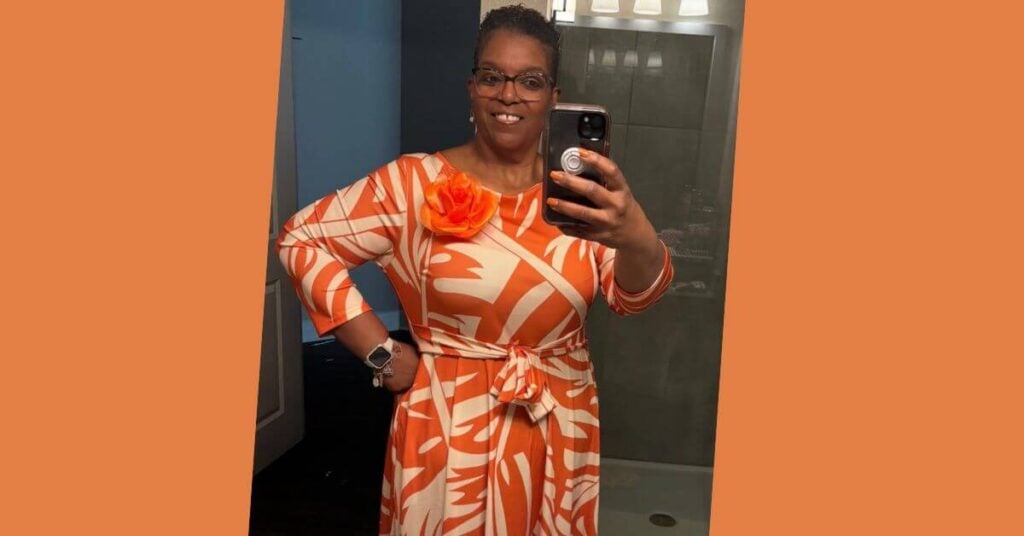
Special thanks to Karen Dixon for sharing her story as part of the national “Don’t Be Embarrassed Campaign” to raise awareness for endometrial cancer. Her story will help women know the signs and symptoms of abnormal vaginal bleeding and pelvic pain that need immediate attention. All women must SPEAK UP when something doesn’t seem right.
Karen was living a very full life prior to her diagnosis. She began noticing changes in her menstruation cycle in her forties — irregular bleeding and spotting that she always thought were typical of menopause.
She had children who needed her, and she did not want to bother anyone with her problems. (HOW MANY TIMES HAVE YOU FELT THIS WAY?) She was leading a very busy life, so she never bothered to mention the bleeding to her doctor, family, or girlfriends. Afterall, it was normal, right?
Menopause is the natural, permanent end of menstruation and fertility, defined as 12 consecutive months without a period, typically occurring between ages 45 and 55 (average age 51-52). Key symptoms include hot flashes, night sweats, irregular periods, and mood changes. It involves three stages — perimenopause, menopause, and post-menopause—with long-term health risks like osteoporosis and heart disease due to declining estrogen.
Then she started spotting again and having pelvic cramping in her sixties. She continued to feel like this must be normal.
Until one night at age 62, Karen woke up in the middle of the night with severe cramping and abdominal pain and serious bleeding. Her intuition told her this was NOT normal.
“Trust your intuition, listen to your body, and speak up.”
At that point, she went to an after-hours clinic immediately. She drove herself because that’s what she was used to doing. Afterall, she never wanted to bother anybody.
The clinic staff was very concerned and sent Karen to a gynecologist immediately. Everything was fast-tracked because of suspicious symptoms. Ultimately, tests indicated she had a large mass that was biopsied and was determined to be nearly a Stage 4 endometrial cancer.
Stage 4 cancer, also known as metastatic cancer, is the most advanced stage, where the cancer has spread from its original site to distant organs, tissues, or lymph nodes. While often not curable, it is treatable, focusing on extending life, managing symptoms, and improving quality of life through systemic therapies.
The gynecologist immediately sent Karen to an oncologist and radiologist at Texas Oncology, where a treatment plan was developed. She would start with surgery for endometrial cancer and a complete hysterectomy.
The team discovered the cancer had gone into her lymph nodes but not out of the lymph nodes. This was a little blessing. She would have full chemo therapy and radiation following the surgery.
Chemo and Radiation Treatments… and Beyond
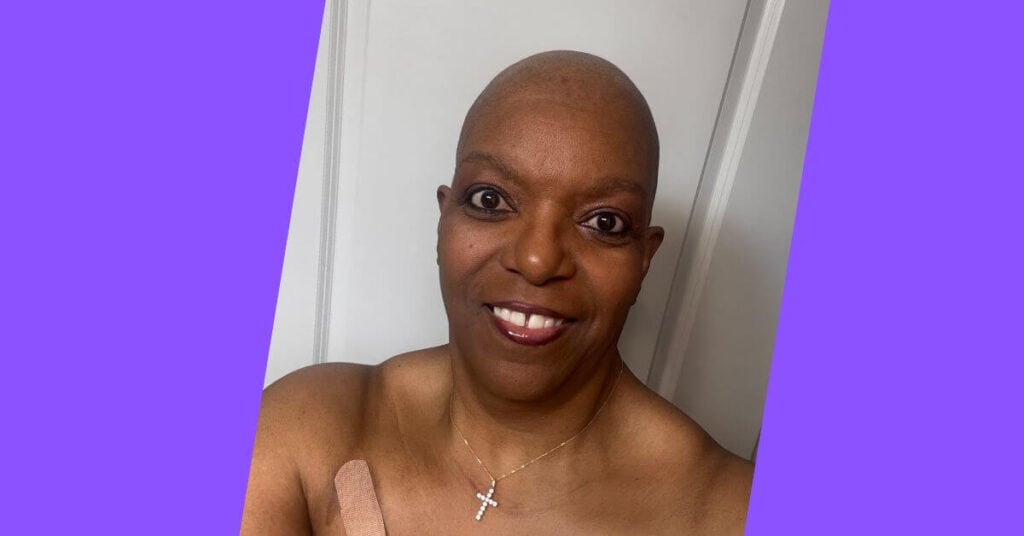
After surgery, Karen had chemo for 6.5 months and radiation for 2 months. She lost her hair and noticed significant changes in her skin. Her fingernails changed colors. As an African American female, she noticed her skin got darker and became quite irritated by the radiation.
Karen’s family pitched in to help during these treatments. It became important for her daughter to come along because she wanted her to know her genealogical history. (Karen’s mother had died recently and she did not know any family medical history.)
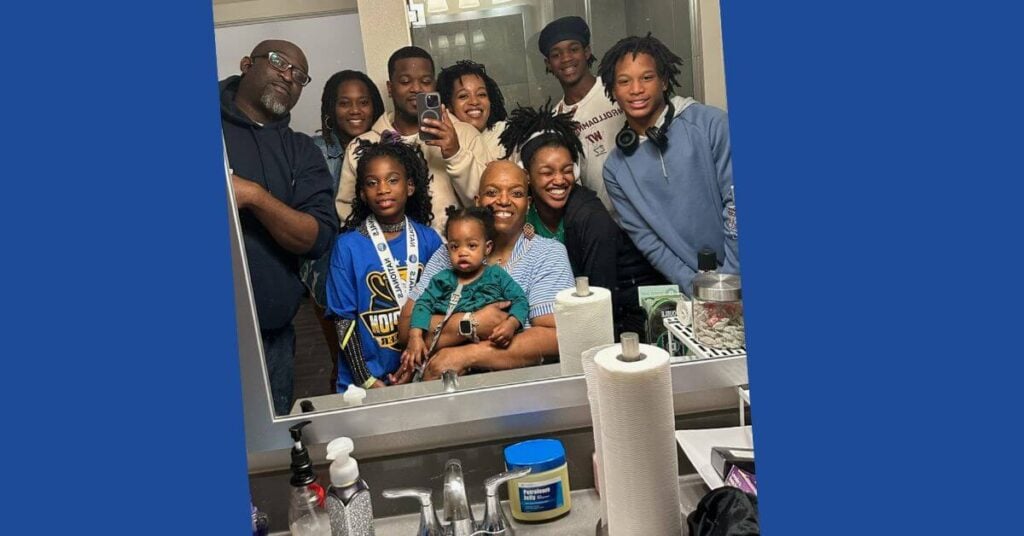
Her other children and grandchildren got involved and pitched in to help, too. One person was her patient navigator for trips back and forth to the hospital. Another person was a home-health coordinator, keeping track of getting help. And when Karen lost her hair, everybody helped shave her head.
Karen’s church family, friends, and coworkers helped, also. She believes it took a village to get her through this experience; this is another reason to SPEAK UP and share what’s happening with your village.
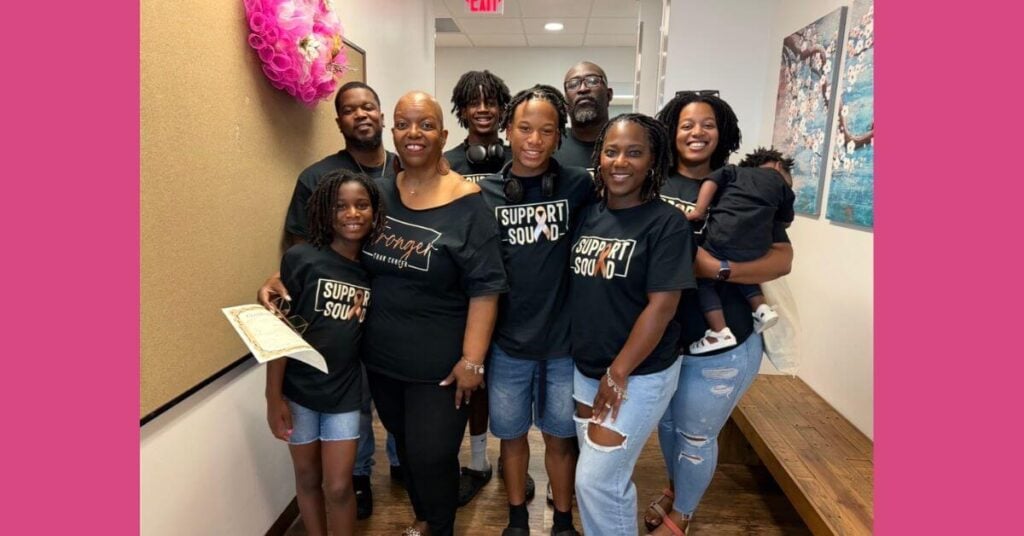
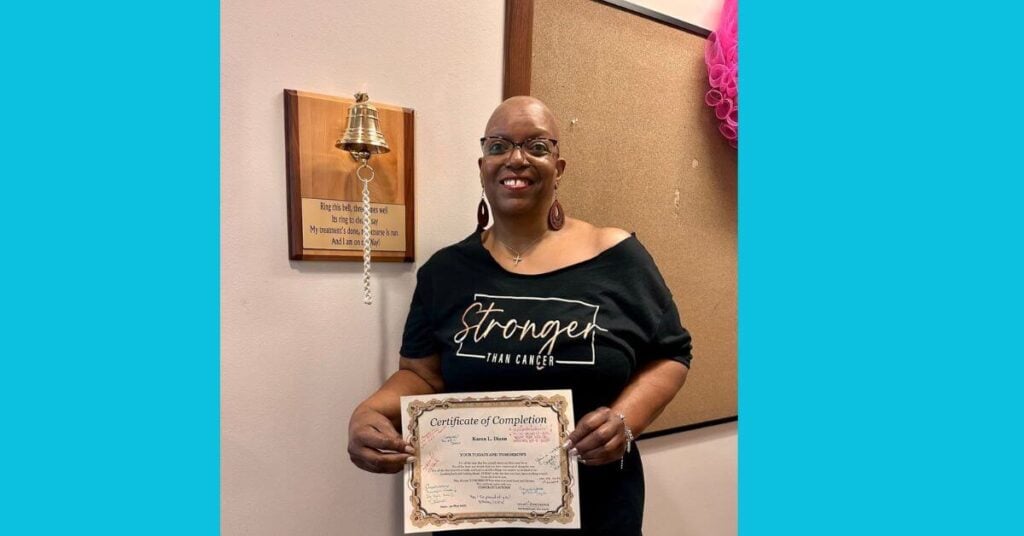
Karen’s whole family came to the hospital the day she rang her bell after radiation was completed!
Even though Karen didn’t want to bother anybody, she realized during this experience that it actually brought her family closer together:)
Following chemo and radiation, the team conducted constant blood tests to see if there was any indication that the cancer was still in her body. They took a thumb print of her cancer cells and looked for that throughout her body.
One year after the initial diagnosis, Karen was given the good news that there was No Evidence of Disease (NED). Therefore, in November 2025, Karen was determined to be in remission! YAY!!
✨Karen was amazingly comfortable with the team at Texas Oncology and she maintained a positive attitude throughout her cancer experience. She believes her positive attitude could have contributed as much as 90% toward her getting better.✨
“It is important to know that endometrial cancer is the most common gynecologic cancer in the United States, yet it often does not receive the same level of public attention as other cancers that affect women.” — Laura Davis, MPAS, PA-C, Sr. Physician Assistant
GKS’s Don’t Be Embarrassed Campaign
Disclosure: Karen is a paid Spokesperson for the GSK “Don’t be Embarrassed” Campaign.
GSK’s Don’t Be Embarrassed Campaign is a disease education campaign designed to break the stigma surrounding gynecologic health, specifically focusing on raising awareness of endometrial cancer. It encourages women to openly discuss symptoms like abnormal vaginal bleeding or pelvic pain with doctors, emphasizing that early conversation can save lives.
The campaign encourages proactive health management and speaking up to ensure early diagnosis and better outcomes. Studies show that early detection leads to 95% survival rate for at least five years. Unfortunately, studies also show that 37% of women with endometrial cancer did not know that post-menopausal bleeding is a symptom of the disease. We can help fix this statistic by speaking up and talking about female issues.
Look at the chart below. Note how some normal menopause symptoms mimic endometrial cancer. You must be tuned into your body to determine whether these signs feel normal or abnormal — but you should consult with your doctor any time you have a concern. You should never feel embarrassed to SPEAK UP and ask questions about your health.
| SYMPTOM | NORMAL MENOPAUSE ISSUES | ENDOMETRIAL CANCER |
|---|---|---|
| Irregular vaginal bleeding | Yes | Yes |
| Pelvic pain | Occasionally | Yes |
| Unintentional Weight loss | No | Yes |
| Weight gain | Yes | Possibly |
| Vaginal discharge | Yes | Yes |
| Gastrointestinal symptoms | Yes | Yes |
Three Critical Takeaways from an Oncology P.A.
Laura Davis, MPAS, PA-C, Sr. Physician Assistant in the Gynecologic Oncology Department at Texas Oncology North Austin was part of Karen’s care team. I was pleased to collect some information from Laura for this article.
“There are three critical takeaways I want every woman to remember. First, any vaginal bleeding after menopause is never considered normal and should always be medically evaluated, even if it is just a single episode of light spotting.
Second, it is a common misconception that a Pap smear screens for endometrial cancer. A Pap smear is designed to screen for cervical cancer, not cancer of the uterine lining. A woman can have a normal Pap smear and still have endometrial cancer. If she is experiencing symptoms such as abnormal bleeding or pelvic pain, those symptoms deserve further evaluation. ( ⬅️ I DID NOT KNOW THIS!)
Finally, women should not feel embarrassed to talk about gynecologic health. We need to normalize these conversations and encourage women to advocate for themselves, because speaking up early can truly make a difference.”
Why This Topic is Important to Me
When I was contacted about writing this article, I accepted immediately. For the past seven years, I’ve written articles about how women can grow, take care of themselves, and live happy lives. I don’t write much about medical issues because I’m not an expert in that area. But talking to Karen, I knew she had become an expert through her own lived experience and journey through endometrial cancer. She was passionate about spreading the word to SPEAK UP and DON’T BE EMBARRASSED about any abnormal bleeding after menopause. I wanted to share her story with other women, like you.
I also had another reason for writing the article….
My college roommate, Mary Kay, died of uterine cancer shortly before we turned sixty. Our birthdays were only five days a part so that’s when we usually caught up with each other. She had moved up north to Connecticut and our lives were now quite different than during our college years. But like usual, I called her to wish her HAPPY BIRTHDAY.
Sadly, I learned that Mary Kay had passed away about six weeks earlier. 😢 She had a young child and stayed very busy taking care of her large Italian family. Her family said she didn’t make time to go to the doctor until it was too late. After she passed away suddenly at her home, they learned about the cancer from tests she had done a few weeks earlier. I was devastated for me but even more for her family.
Please SPEAK UP and DON’T BE EMBARRASSED to talk about female issues, especially in midlife and beyond. You matter. Statistics show that early intervention can save lives.
Final Thoughts about a Journey Through Endometrial Cancer
Karen believes that one woman speaking up can make a difference. That’s why she accepted the role of spokesperson for the Don’t Be Embarrassed Campaign. We both hope you’ll SAVE this article in a place where you can find it later and share it with other women.
Statistics about Gynecological Cancers
Here are more statistics to help you understand the importance of seeing a doctor right away about any postmenopausal bleeding.
These statistics reveal an interesting perspective about women’s health:
- 42% of gynecologic cancer patients didn’t want to trouble anyone with their symptoms;
- 78% of women in the United States believe that periods have a gross or unsanitary connotation;
- 64% of women report feeling unprepared for the transition to menopause.
With statistics like these, we need to change the narrative about menstruation. And women need to be the change.
From the Don’t Be Embarrassed Digital Brochure, “Gynecologic health is never something to be embarrassed about. Ever.”
More Statistics and Risk Factors about Endometrial Cancer
- Endometrial cancer is the most common form of gynecologic cancer in the US, with 62,000 new cases estimated to be diagnosed in 2025. That’s more than 160 women every single day — about one every 9 minutes — receiving a life-altering diagnosis. In the US alone, nearly 12,500 women were estimated to die from endometrial cancer in 2025.
- Nearly 70% of women with endometrial cancer were diagnosed at an early stage due to warning symptoms like abnormal or postmenopausal bleeding. These early detections led to a 95% chance of surviving the cancer for at least 5 years.
- Around 37% of women didn’t recognize postmenopausal bleeding as a symptom of endometrial cancer. Women diagnosed with distant endometrial cancer, which means it had spread outside of the endometrium, had worse outcomes, with less than a 19% chance of surviving the cancer for at least 5 years.
- Higher body weight and diabetes may put you at a higher risk for endometrial cancer. In the US, 57% of cases of endometrial cancer are attributed to obesity. Obesity is more strongly associated with endometrial cancer than any other type of cancer.
- Additional risk factors include:
- Advanced age
- Early menarche (first period) and/or late menopause
- Family history
- No history of pregnancy
- Cowden syndrome
- Lynch syndrome
- Polycystic ovary syndrome
A Final Message from Laura Davis, MPAS, PA-C
“We are unfortunately seeing a steady rise in endometrial cancer cases, and several factors are likely contributing to that trend.
One major factor is the increasing prevalence of obesity, because fat tissue can convert other hormones into estrogen. Over time, higher levels of unopposed estrogen can stimulate the uterine lining and increase the risk of endometrial cancer.
We are also seeing concerning increases among younger and premenopausal women, which may be related in part to conditions such as polycystic ovary syndrome, type 2 diabetes, and other metabolic health issues.
Understanding these connections is important because it helps women and their health care providers have more informed conversations about risk, symptoms, and prevention.”
I want to say THANK YOU to Karen again for sharing her journey through endometrial cancer. It’s been a pleasure to collaborate with her. I also appreciate Laura’s contribution to the article.
You will love this companion article:
I hope you’ve found value and inspiration in this article. 🙏🏻✨
Take good care of yourself, friend! I care… and you matter.
With light and love,
Susan